

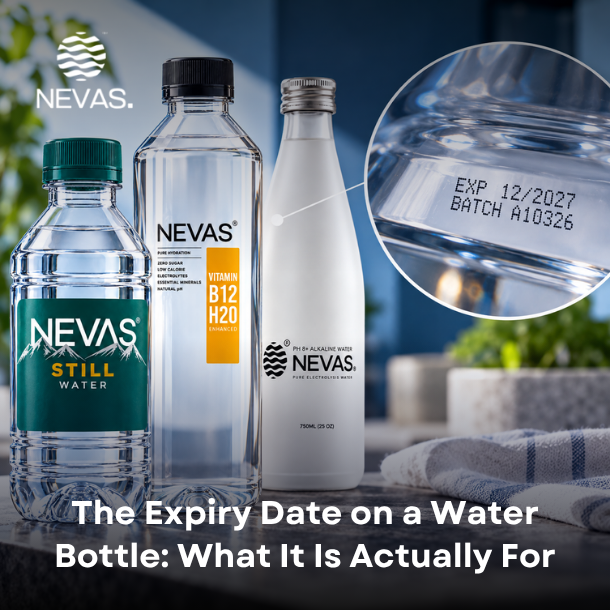
You've done it. Everyone has. You pick up a water bottle, flip it around, squint at the bottom, and notice a date stamped there. And then the question arrives does water actually expire?
It seems almost absurd. Water is water hydrogen and oxygen. It doesn't rot, ferment, or go stale. And yet every packaged drinking water bottle you've ever bought has a date printed on it. Supermarkets pull bottles past that date. Manufacturers insist on it.
So what is the expiry date on a water bottle actually for? The answer is more interesting and more practical than most people realise.
Water Doesn't Expire. The Bottle Does.
This is the core truth behind every date you'll find on a packaged drinking water bottle, and it reframes the entire question.
Pure water, in isolation, has no shelf life. It cannot spoil in the way food does. There are no organic compounds to decay, no proteins to break down, no sugars to ferment. Left entirely undisturbed in a chemically inert container, water remains water indefinitely.
The expiry date is not about the water. It's about the container.
Plastic even high-grade, food-safe PET plastic is not perfectly inert over time. When exposed to heat, UV light, or simply the passage of months, plastic begins a slow process of degradation. Microscopic quantities of chemical compounds including acetaldehyde and antimony, which are used in PET plastic production can migrate into the water the bottle holds.
The expiry date marks the point beyond which the manufacturer cannot guarantee that migration remains within safe limits. It's a packaging integrity date, not a water freshness date.
What Happens When a Packaged Drinking Water Bottle Is Stored Incorrectly?
The expiry date assumes correct storage conditions. When those conditions aren't met, the timeline compresses sometimes significantly.
Heat is the primary accelerant. A water bottle left in a hot car, exposed to direct sunlight on a shelf, or stored near a heat source degrades the plastic at a dramatically faster rate than one kept in a cool, dark environment. The same bottle that would be perfectly safe at 12 months under proper storage may become questionable at 6 months if it's been repeatedly heat-stressed.
UV light compounds the problem. Direct sunlight doesn't just heat the bottle UV radiation actively breaks down the polymer chains in PET plastic, accelerating the migration of compounds into the water. This is why reputable packaged water brands specify storage away from direct sunlight on their labels.
Physical damage matters too. A cracked, dented, or compromised bottle one whose seal has been weakened no longer offers the same protective barrier between the water and its environment. Once integrity is broken, the water is vulnerable to contamination from the outside, not just the plastic.
This is why you should always check the physical condition of a packaged drinking water bottle before purchasing or consuming it, not just the date on the label.
Shop Nevas Water Packaged Drinking Water →
How Long Is a Packaged Drinking Water Bottle Actually Safe?
In India, the Bureau of Indian Standards (BIS) mandates a shelf life declaration on packaged drinking water under IS 14543. Most certified brands set this at 12 months from the date of packaging for PET bottles though premium mineral water and glass-bottled water may carry different timelines based on their specific packaging materials.
For practical purposes:
1. PET packaged water, properly stored (cool, dry, dark): Safe up to and through the printed expiry date
2. PET packaged water, stored in heat or sunlight: Best consumed significantly before the printed date
3. Glass-bottled water: Glass is chemically inert and does not leach compounds the shelf life concern is dramatically reduced, making glass the superior long-term storage format
4. Opened bottles: Consume within 24–48 hours, regardless of the printed date once opened, the water is exposed to the environment and potential contamination
What the Expiry Date Is Protecting You From
To be specific about the chemistry: the two primary compounds associated with PET plastic degradation are acetaldehyde and antimony.
Acetaldehyde is a byproduct of PET production that can gradually migrate into water stored in PET bottles over time. At low levels, it primarily affects taste giving water a slightly sweet or plastic-like flavour. At higher concentrations (associated with heat exposure or very extended storage), it raises broader safety concerns.
Antimony is a catalyst used in PET manufacturing. Studies have found that antimony concentration in water stored in PET bottles increases with time and heat exposure particularly when bottles are stored in conditions above 40°C, which is not uncommon in Indian summers or in vehicles.
Neither of these represents an acute health crisis at the concentrations found in properly stored, within-date bottles. But they are precisely what the expiry date is designed to keep within safe limits and why the storage conditions are not fine print to be ignored.
Why Glass Bottles Are a Different Conversation Entirely
Everything above applies to plastic. Glass changes the equation fundamentally.
Glass is completely chemically inert. It does not degrade over time, does not react with water, and does not release any compounds regardless of temperature (within normal storage ranges), UV exposure, or duration of storage. The water inside a properly sealed glass bottle remains entirely unaffected by its container throughout the product's shelf life.
This is why Nevas Alkaline Water in Glass Bottles available in 300ml and 750ml represents the most honest, highest-integrity packaged water format available. The chemistry of glass means that what was sealed into the bottle on the day of production is exactly what you drink no migration, no degradation, no question about what the bottle has contributed to the water inside.
For premium hospitality, family use, and anyone who thinks carefully about what goes into their body daily, glass is the category of packaged drinking water where the expiry date conversation becomes almost irrelevant because the container is never the variable.
What to Check Before Drinking Any Packaged Water
Regardless of the expiry date, a brief check before consuming any packaged drinking water bottle is worth the ten seconds it takes:
The seal - A tamper-evident cap should be intact and unbroken. If the seal is missing, broken, or looks like it has been resealed, discard the bottle.
The date - Check both the manufacturing date and the best-before date. If either is absent or illegible on a bottle claiming BIS certification, that's a serious red flag.
The bottle condition - Cracks, deep dents, cloudiness, or discolouration of the plastic are all indicators that the container's integrity may be compromised.
The taste and smell on opening - Premium packaged water should have no odour and a clean, neutral taste. Any plastic smell or unusual taste regardless of the date is a signal to stop consuming and report to the brand.
Storage conditions at point of sale - Water that has been sitting in direct sunlight at a roadside stall or in a poorly ventilated stockroom may have degraded faster than its date suggests. Purchase from temperature-controlled environments where possible.
Choose Water You Can Trust
The best protection against the concerns outlined above is choosing a brand that takes packaging integrity seriously one with verifiable BIS and FSSAI certification, rigorous zero-contact bottling, and the option of glass packaging for those who want to remove the plastic variable entirely.
Nevas Water is exactly that. Every bottle from the 750ml alkaline to the 1L still water to the frosted glass range is produced through a 13-stage filtration process with zero human contact during bottling, and certified to meet the highest Indian food safety standards.
How Nevas Approaches Packaging Integrity
Nevas bottles carry:
1. FSSAI certification India's national food safety authority compliance
2. BIS ISI mark Bureau of Indian Standards certification for packaged drinking water
3. Tamper evident seals on every bottle visible integrity assurance from production to your hands
4. Zero human contact bottling automated production that eliminates handling stage contamination
5. Glass bottle options for consumers who want to remove the plastic variable entirely
Every date on a Nevas bottle is a genuine quality commitment not a legal formality.
Conclusion
The expiry date on a packaged drinking water bottle has nothing to do with water going bad. It has everything to do with the container that holds it and the point at which a manufacturer can no longer guarantee that the packaging has not altered the water inside.
Understanding this doesn't make packaged water unsafe. It makes you a smarter consumer. Choose certified brands. Store correctly. Check the seal. Consider glass when you want to remove the packaging variable altogether.
Clean water is simple. What matters is keeping it that way from the source all the way to your glass.
Frequently Asked Questions
1. Can I drink water past its expiry date?
If stored correctly (cool, dark, sealed), the risk is low but the manufacturer's quality guarantee no longer applies. When in doubt, don't especially if the bottle has been exposed to heat or sunlight.
2. Why does water have an expiry date if water doesn't go bad?
The date refers to the packaging, not the water it marks when plastic may begin leaching compounds into the water at levels beyond the manufacturer's guaranteed safe limit.
3. Is water stored in a hot car safe to drink?
Not recommended. Heat significantly accelerates plastic degradation and increases the migration of compounds into the water regardless of the printed date.
4. Does glass-bottled water expire?
Glass is chemically inert and doesn't degrade into the water. The shelf life on glass-bottled water is primarily a quality assurance standard rather than a packaging safety concern.
5. How should packaged drinking water be stored at home?
Cool, dry, away from direct sunlight and strong odours. Avoid storing near cleaning products, paints, or fuel plastic is mildly porous to strong vapours over extended periods.


